


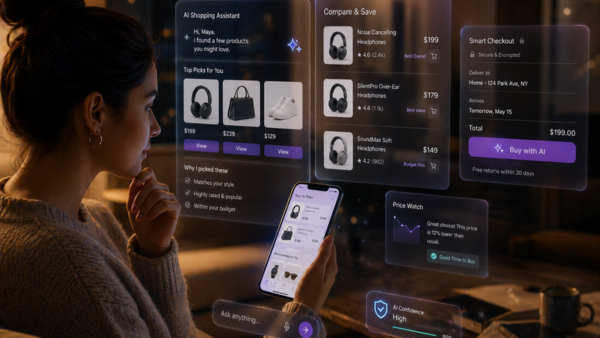
Shopping is starting to shift from search-and-click to delegate-and-approve.
That is the core idea behind agentic commerce. Instead of manually comparing products, hunting for discount codes, checking shipping, and filling carts yourself, an AI agent does the work for you. It can research options, narrow choices, monitor prices, and in some cases move all the way to transaction-ready checkout. That is no longer just a theory. Visa has launched Visa Intelligent Commerce to support trusted AI-driven purchases, Mastercard has rolled out Agent Pay and related agent-commerce tools, and Stripe now offers an Agentic Commerce Suite built to help sellers surface products and accept purchases from AI agents.
Why This Feels Bigger Than A Shopping Trend
Agentic commerce matters because it changes what part of shopping gets automated.
Earlier e-commerce tools mostly helped people search faster. This new wave is trying to help software act on a shopper’s behalf. That makes shopping feel less like browsing and more like delegation. Adobe’s recent reporting found AI-driven traffic to retail sites rising sharply and outperforming traditional traffic on engagement, conversion, and revenue per visit, which suggests shoppers arriving through AI systems are often showing stronger purchase intent.
Why Payments Companies Are Moving So Fast
The biggest signal that this is real is not the chatbots. It is the payments infrastructure.
Visa and Mastercard are not treating AI shopping agents like a side experiment. They are building standards, controls, and payment rails around them. Visa says its system is designed to let issuers and partners enable secure agent-led purchases at global scale, while Mastercard is positioning Agent Pay around trusted, seamless agentic payments and has already publicized live agent-initiated transactions in parts of Latin America.
That matters because the hard part of AI shopping is not recommending a blender. It is handling trust, authorization, identity, and payment without making the whole process feel risky.
Why Consumers May Actually Like This
People do not usually enjoy the most repetitive parts of online shopping.
They like deciding. They do not always like filtering through endless listings, comparing near-identical options, checking reviews across tabs, or watching prices for a week. Agentic commerce is appealing because it promises to automate the tedious middle. Earlier Adobe consumer data found that many U.S. shoppers were already using generative AI for online shopping tasks such as research, recommendations, deal-finding, gift ideas, and shopping-list creation.
The next step is obvious: if consumers already trust AI to help them choose, many will eventually want it to help them act.
What Could Slow It Down
This shift is not frictionless.
The biggest barriers are trust, platform control, and security. Reuters recently reported that Amazon won a court order blocking access for Perplexity’s AI shopping agent after alleging improper automated access and security risks tied to customer accounts. That case shows exactly where agentic commerce gets messy: platforms may not want outside agents moving freely through their ecosystems, especially if those agents weaken advertising, search placement, or direct customer control.
So the future of agentic commerce may depend less on whether the technology works and more on which companies get to be the trusted middle layer.
What Replaces Traditional Shopping
The likely replacement is not fully autonomous shopping for everything. It is guided autonomy.
For routine purchases, repeat buys, travel planning, replenishment, deal hunting, and comparison-heavy categories, shoppers may increasingly let agents do the legwork and only step in for final approval. That hybrid model fits what Visa, Mastercard, Stripe, and Adobe are all signaling from different angles: AI is becoming part of the commerce workflow, but trust and control still need to stay visible.
Agentic commerce is really about turning shopping into a managed task instead of a manual chore. The consumer still sets the goal, the preferences, and the limits. The agent handles the mess in the middle. If that model holds, the future of online shopping may feel less like scrolling through digital shelves and more like having a highly efficient buyer working quietly in the background.
Comments
No comments yet. Be the first to share your thoughts.
Log in to add a comment.