


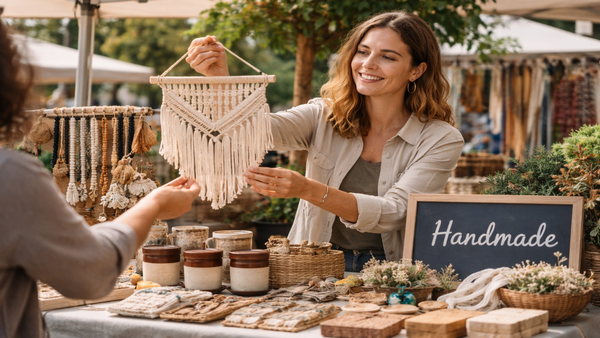
There is a reason handmade ceramics, small-batch coffee, live music, hand-bound books, custom clothing, and human-written notes still hold power in a world built for speed.
People do not just buy objects. They buy meaning. And the more automated, optimized, and AI-assisted the world becomes, the more valuable visibly human work can feel. Brands across fashion, luxury, and marketing are increasingly leaning on authenticity, craftsmanship, heritage, and emotional connection because consumers are responding to those signals.
Why Human-Made Still Feels Different
When something is made by a person, it often carries evidence of effort. There may be slight imperfections, unusual choices, texture, warmth, or a point of view that does not feel machine-smoothed. That is part of the appeal.
Human-made work suggests care. It suggests time. It suggests that someone, somewhere, touched this, shaped it, revised it, and stood behind it. In a culture flooded with fast content and mass production, that kind of signal feels rare.
The Premium Is Emotional Before It Is Financial
The “human premium” is not only about price. It is about perceived value.
People will often pay more when they believe a product has a story, a maker, a craft, or a soul behind it. That is why heritage brands continue to emphasize craftsmanship, why luxury still sells through labor and scarcity, and why authenticity remains such a powerful marketing word. Consumers are not only evaluating usefulness. They are evaluating connection.
A machine can make something faster. That does not automatically make it feel more valuable.
Why AI May Increase the Human Premium
Ironically, the rise of AI may make human-made work even more desirable.
As more writing, design, visuals, music, and products become easier to generate, the marketplace gets noisier. When abundance rises, distinction matters more. Human involvement becomes part of the product itself. It becomes a feature, not a background detail.
That is already shaping how brands talk about trust, creativity, and authenticity. Even as AI expands, marketers and creators are finding that people still respond strongly to work that feels personal, credible, and emotionally real.
What People Are Really Paying For
In many cases, consumers are paying for four things at once: skill, scarcity, story, and signal.
Skill means a person knows how to do something difficult well. Scarcity means it cannot be duplicated endlessly without losing something. Story gives the item emotional texture. Signal allows the buyer to express taste, values, discernment, or identity.
That is why a hand-thrown mug can feel more special than a factory-perfect one. It is why a chef’s tasting menu can feel different from convenience food. It is why a handwritten thank-you note can land harder than an automated email. The value is not only in the object. It is in the human trace.
The Pushback Against Frictionless Everything
For years, consumers were trained to want faster, cheaper, more convenient, more scalable. That logic still matters. But it is no longer the whole story.
There is growing fatigue around things that feel flattened, generic, or too optimized. In response, many people are looking for texture again. They want products, experiences, and media that feel lived in rather than mass-produced. That helps explain why craftsmanship, relatability, and authenticity remain strong cultural and commercial signals.
The future may belong to businesses that know when to automate and when to stay unmistakably human.
The “human premium” is really about trust in visible form. It tells people that a real person cared enough to make choices, take time, and leave fingerprints behind. In a world where more things can be produced instantly, the things that still feel personal may become the ones people value most.
Comments
No comments yet. Be the first to share your thoughts.
Log in to add a comment.