


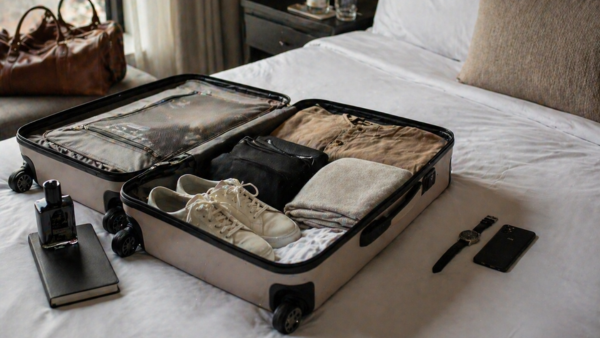
The fantasy of the perfect trip used to include more stuff. More outfits, more backup shoes, more “just in case” extras, and a suitcase heavy enough to make you regret every staircase.
Now the smarter flex is traveling lighter.
Minimalist packing has become more appealing because modern travel punishes excess. Airlines still vary, but IATA says many carriers use carry-on dimensions around 56 x 45 x 25 cm, and some impose weight limits starting at 5 kg. That reality alone makes lighter, tighter packing feel less like a niche travel hack and more like practical strategy.
Why The Minimalist Suitcase Feels So Powerful
A small suitcase changes the emotional experience of travel.
You move faster. You stress less. You stop negotiating with your own baggage at every airport, train station, taxi trunk, hotel stairwell, and crowded sidewalk. The minimalist suitcase is not just about saving space. It is about reducing drag.
That is why one-bag and carry-on-only travel keep resonating. Recent travel coverage has leaned into capsule-style packing systems like the 3-3-3 rule because travelers are actively looking for ways to build more outfits from fewer pieces.
Why 10 Items Can Actually Be Enough
The secret is not deprivation. It is coordination.
Ten well-chosen items can go much further than twenty random ones if they layer easily, mix well, and fit multiple settings. The real minimalist suitcase works like a portable uniform: a few interchangeable clothing pieces, one solid shoe strategy, and a focus on items that earn repeat use.
A smart version might look like this:
- 3 tops
- 2 bottoms
- 1 layering piece
- 1 lightweight outer layer
- 1 dress or secondary all-purpose piece
- 1 pair of everyday shoes
- 1 sleep or lounge item
That kind of structure mirrors why capsule packing systems have gained traction in current travel coverage: the goal is not endless variety, but maximum combination value from a small set.
The New Luxury Is Mobility
Minimalist packing feels modern because it prioritizes freedom over abundance.
You do not need to check a bag. You do not need to wait at baggage claim. You are less likely to lose time, lose money, or lose patience. Travel + Leisure’s recent packing and luggage coverage has emphasized compression tools, lighter bags, and personal-item discipline because travelers are increasingly optimizing around ease, not excess.
That is a big cultural shift. The impressive traveler is no longer the one with the biggest case. It is the one gliding through the terminal with something small, light, and under control.
How To Make 10 Items Work In Real Life
The trick is choosing pieces that can survive repetition without feeling repetitive.
That usually means:
- a narrow color palette
- fabrics that layer well
- shoes that work for walking and casual dinners
- one item that can dress the whole bag up
- at least one piece that handles weather swings
This is where minimalism stops being aesthetic and becomes functional. Once you pack with coordination in mind, you stop treating every day of the trip like a separate costume change.
Why Travelers Are Done Packing For Imaginary Scenarios
Most overpacking comes from anxiety, not need.
People pack for the version of the trip where everything goes wrong, every social occasion changes, every temperature swings wildly, and every outfit needs to be unique. In reality, most travelers wear the same favorite pieces over and over. The minimalist suitcase simply admits that upfront.
It also forces better decisions. Instead of throwing in clutter, you choose pieces you actually trust. That makes the whole bag stronger.
What The Minimalist Suitcase Really Represents
This trend is bigger than packing. It reflects a different travel mindset.
Travel feels better when you are carrying less physical and mental weight. A 10-item suitcase works because it turns travel back into movement instead of luggage management. It is not about proving how little you can survive with. It is about bringing only what helps the trip feel lighter, cleaner, and easier to live inside.
The minimalist suitcase is appealing for the same reason capsule wardrobes, quiet travel, and carry-on-only habits keep growing: people want less friction. And once you experience a trip where your bag does not own you, it becomes very hard to go back.
Comments
No comments yet. Be the first to share your thoughts.
Log in to add a comment.