


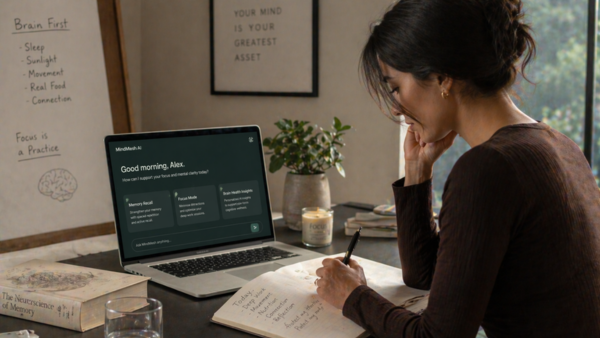
“Neuro-wellness” is starting to sound like the next big self-care phrase, but the deeper story is not really about supplements, nootropics, or brain-hack branding.
It is about attention, memory, judgment, and mental stamina in a culture that is increasingly tempted to outsource all four. As AI gets better at summarizing, drafting, recommending, organizing, and answering, the new premium may be human cognition itself. That broader concern is not imagined. WHO defines brain health as the state of functioning across cognitive, sensory, social-emotional, behavioral, and motor domains, and it emphasizes that lifelong learning, healthy environments, physical health, and social connection all shape how our brains adapt and respond.
Why “Neuro-Wellness” Feels Suddenly Urgent
The current version of wellness is shifting from how we look to how clearly we can think.
People are feeling the effects of constant prompts, constant inputs, and constant digital assistance. AI can be incredibly useful, but usefulness has a tradeoff when it quietly lowers the amount of effort we bring to everyday thinking. Microsoft researchers reported in 2025 that in a survey of 319 knowledge workers, people described reduced critical-thinking effort in some GenAI-assisted tasks, especially when they felt highly confident in the tool or viewed the task as low stakes.
That is the real spark behind the neuro-wellness conversation. It is not anti-AI panic. It is the growing realization that convenience can become cognitive atrophy if every hard mental move gets outsourced by default.
AI Is Not Just Replacing Tasks. It Is Rewiring Habits
The more interesting question is not whether AI is good or bad. It is what kinds of habits it rewards.
When people use AI as a shortcut for first drafts, memory retrieval, idea generation, and decision framing, they may save time. But they may also practice less recall, less evaluation, and less deep synthesis. A 2025 study of university students found that greater AI dependence was associated with lower levels of critical thinking, with cognitive fatigue partially explaining the relationship; the study also found that information literacy helped buffer some of the negative effect.
That matters because neuro-wellness is not just about having a healthy brain in the abstract. It is about protecting the everyday mental behaviors that keep cognition strong: remembering, comparing, judging, focusing, and resisting the urge to let the machine finish every thought for you.
The Goal Is Not Less Technology. It Is Better Friction
One reason this conversation is getting traction is that people are starting to see “friction” differently.
Not every form of effort is a problem. Some effort is the workout. Recalling information from memory, reading something slowly, outlining your own argument, sitting with uncertainty, and making decisions without instant assistance are not inefficiencies to eliminate. They are part of how mental sharpness is maintained.
A recent review in Humanities and Social Sciences Communications described cognitive offloading as something that can improve efficiency and problem-solving, while also warning that tool reliance can become maladaptive when it reduces metacognitive awareness and healthy judgment.
That is a useful way to think about neuro-wellness. The issue is not using external tools. Humans have always done that. The issue is whether the tool supports thinking or replaces it so thoroughly that the underlying skill weakens.
What Reclaiming Cognitive Function Actually Looks Like
The strongest version of neuro-wellness is surprisingly low-tech.
It looks like reading without skipping. Writing without predictive help for part of the process. Memorizing some things on purpose. Letting your brain retrieve information before you search. Using AI after you think, not before. Choosing depth over constant summarization. Protecting sleep, movement, and social connection because brain health is not just a productivity issue; it is a whole-life issue. WHO’s brain-health framework explicitly links cognitive well-being to physical health, safe environments, lifelong learning, and social connection.
This is also why the idea has commercial and cultural momentum. The World Economic Forum’s 2026 report on “stronger brains in the age of AI” frames brain health and brain skills as economic and human priorities, not niche concerns.
Why This Trend Will Probably Grow
Neuro-wellness has the kind of appeal that fits the current moment almost perfectly.
It speaks to burnout without sounding purely emotional. It speaks to productivity without sounding cold. It gives people a language for something many already feel: that digital convenience is not always making them feel mentally stronger. Sometimes it is making them feel fuzzier, more passive, and less sure of what their own minds can still do without help.
That is why this idea may stick. It names a new status symbol. Not just being efficient. Not just being optimized. Being mentally intact.
The next wave of wellness may be less about adding one more product and more about protecting the human capacities that are easiest to dull when everything becomes assisted. Neuro-wellness, at its best, is really a decision to stay cognitively alive inside an AI-heavy world. It is the choice to use tools without surrendering the internal muscles that make thought, judgment, and originality feel like your own.
Comments
No comments yet. Be the first to share your thoughts.
Log in to add a comment.