


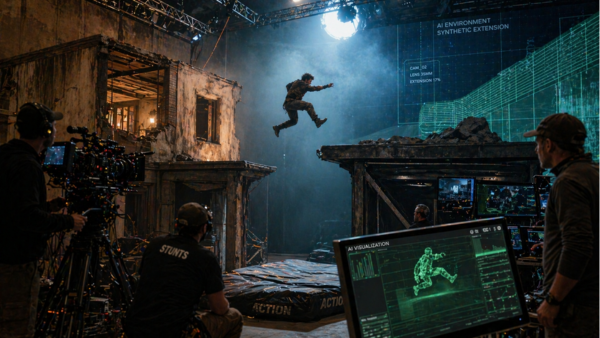
For years, spectacle kept getting bigger, cleaner, and more digitally perfect. Now the cultural mood seems to be shifting. In an era when AI can alter performances, generate imagery, and smooth away friction, audiences are becoming more sensitive to what feels physically real. That tension is visible across the industry: the Academy created a new Oscar for Achievement in Stunt Design beginning with films released in 2027, while recent debates around AI-generated performances and AI-enhanced film experiences have sharpened concerns about authenticity, labor, and what exactly audiences are looking at.
Why “Real” Suddenly Feels More Valuable
Practical stunts offer something digital spectacle often struggles to replicate: visible risk, physical weight, and the feeling that a human body really had to do something difficult. That does not mean audiences reject visual effects. It means “real” has become a premium signal. Reuters described the racing scenes in F1 as impressively authentic, and Mission: Impossible continues to market Tom Cruise’s commitment to practical stunt work as a defining attraction, strong enough to anchor a museum exhibition around the franchise’s stunt legacy.
AI Makes Human Skill More Legible
The more AI enters entertainment, the more people seem to value the parts of filmmaking that still look unmistakably human. Recent Reuters reporting shows how AI use in film is expanding, from digitally recreated performances to large-scale AI-enhanced visual experiences, but those same stories also highlight backlash from audiences, unions, and cinephiles worried about creative replacement and artistic integrity. In that environment, practical stunt work feels like proof. It is not just action. It is evidence that real people trained, coordinated, and executed something in front of a camera.
Practical Stunts Create Trust
A practical stunt also changes how viewers watch. When people believe a sequence was largely done for real, the scene can carry more tension because the illusion feels anchored in physics. That helps explain why practical action remains such a strong selling point in franchises built on immersion and edge-of-your-seat momentum. It also helps explain why the stunt community’s work is receiving new institutional recognition: the Academy’s new stunt design category is an acknowledgment that stunt work is not just background danger, but a core creative craft in modern filmmaking.
What Audiences Really Want Now
What people seem to crave is not a total rejection of technology. It is a better balance. Viewers still want scale, but they also want texture. They still want innovation, but not at the cost of human presence. The likely future is not anti-AI filmmaking. It is filmmaking where practical stunts, real-world action, and visible human craftsmanship become even more important because they give digital-heavy entertainment something increasingly rare: credibility. In a world where more can be fabricated, the things that still look physically earned may become the things audiences value most.
Comments
No comments yet. Be the first to share your thoughts.
Log in to add a comment.