


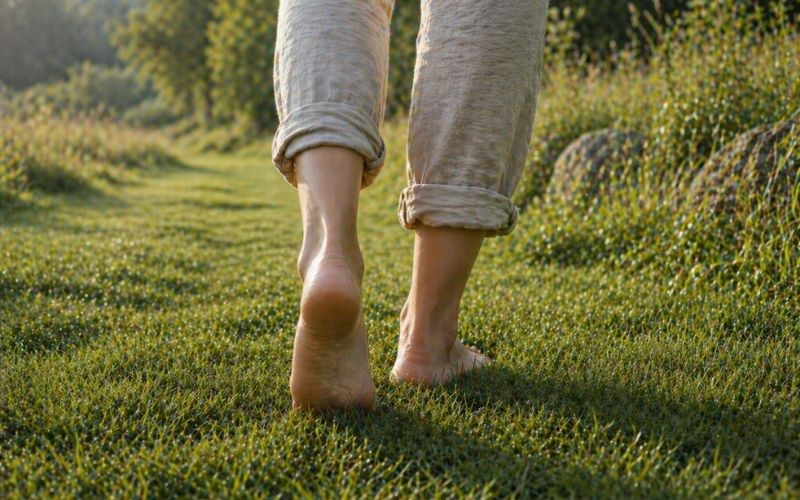
Grounding has a great wellness story behind it.
The idea is simple and emotionally appealing: take off your shoes, reconnect with the Earth, and let that contact improve everything from stress to sleep to inflammation. It sounds ancient, natural, and strangely modern at the same time. But once you move from wellness language into medical evidence, the picture gets more complicated. Major clinical sources say grounding or “earthing” may feel good and is generally safe for most people, but the evidence for broad health claims is still limited and not strong enough to treat it like proven medicine.
What Grounding Actually Claims
Grounding usually refers to direct skin contact with the Earth, often by walking barefoot on grass, sand, or soil. Supporters argue that this contact allows the body to absorb electrons from the ground, which they say can reduce inflammation, improve sleep, calm stress, and support recovery. Those claims appear repeatedly in grounding research papers and wellness coverage, but many of the studies behind them are small, preliminary, or written by researchers who are highly supportive of the concept.
What The Better Evidence Really Says
This is where the topic needs a little honesty.
There are studies suggesting possible benefits for sleep, stress, pain, and recovery markers, but the evidence base is still thin. Many grounding papers are pilot studies, involve small sample sizes, or are not the kind of large, rigorous trials that would settle the question clinically. Cleveland Clinic’s take is basically this: earthing is safe for most people, might have some positive effects, but should be treated as a complement to evidence-based care, not a replacement for it.
Barefoot Walking May Help For Reasons That Have Nothing To Do With Electrons
This may be the most important part of the whole conversation.
Walking barefoot outside can absolutely make some people feel better. But that does not automatically prove the grounding theory. A barefoot walk also means movement, fresh air, sunlight, time in nature, lower stress, sensory stimulation, and a break from screens and indoor routines. All of those things can improve mood and well-being on their own. Even Cleveland Clinic’s explanation leaves room for the possibility that part of the benefit may come from the overall experience of being outdoors rather than the electrical theory itself.
Why The Claims Get Ahead Of The Science
Grounding is one of those ideas that sits in the sweet spot of modern wellness.
It feels natural, low-cost, and anti-pharmaceutical. It also offers a very clean explanation for messy health problems. That makes it easy to market. But health claims need stronger proof than a compelling concept. When research is early, small, or difficult to separate from other lifestyle effects, it is smarter to treat the practice as promising or pleasant rather than proven. That is especially true when the claims stretch into inflammation, blood pressure, chronic pain, or disease-related outcomes.
So Can Walking Barefoot Improve Your Health?
Possibly, but probably in a narrower and more ordinary way than the strongest grounding claims suggest.
Walking barefoot outside may help some people feel calmer, more connected, and less stressed. It may support relaxation, mindfulness, and gentle physical activity. Some early studies hint at broader physiological effects, but the current evidence does not clearly prove that grounding itself delivers major health improvements across the board.
The Most Practical Takeaway
Grounding is probably best understood as a low-risk wellness habit, not a medical breakthrough.
If walking barefoot on grass helps you slow down, feel better, and spend more time outside, that is already meaningful. You do not need to oversell it for it to be worthwhile. The strongest version of the habit may simply be this: being outside, moving your body, and paying attention to the physical world is good for you, even if the science has not fully confirmed every grounding claim attached to it. And that may be enough reason for many people to keep doing it.
Comments
No comments yet. Be the first to share your thoughts.
Log in to add a comment.