


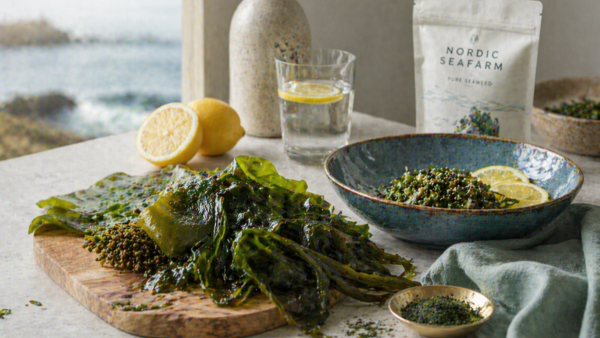
For years, many people mostly associated it with sushi wrappers, beach debris, or niche health-food aisles. Now it is being reframed as something much bigger: a nutrient-dense food, a sustainability symbol, and a rare ingredient that connects personal wellness with ocean awareness. That shift is happening at the same time seaweed is getting more attention from food researchers, aquaculture planners, and sustainability advocates who see it as one of the more promising marine crops in the global food system. FAO says seaweed is increasingly recognized as a nutritious and sustainable food source, and NOAA says seaweed aquaculture can absorb nutrients and carbon dioxide as it grows while helping improve water quality in surrounding areas.
Why Seaweed Sounds So Right Right Now
Seaweed fits the current food mood almost perfectly.
People want ingredients that feel functional, natural, and tied to a larger story. Seaweed checks all three boxes. FAO notes that edible seaweed is rich in nutrients including vitamins, dietary fiber, unsaturated fatty acids, and polysaccharides, while recent FAO guidance for sustainable seaweed farming also highlights its iodine and micronutrient value.
That makes seaweed attractive not only as a wellness ingredient, but as a food with a built-in narrative of depth, simplicity, and environmental relevance.
Why Ocean-Conscious Consumers Like It
Seaweed has unusual sustainability appeal because it grows in the ocean without needing freshwater, cropland, or conventional feed inputs. Pew recently described seaweed as a major underused resource and emphasized that it does not need to be fed, does not require pesticides, and does not need freshwater to grow. NOAA also says seaweed farms can help buffer ocean acidification in surrounding areas and improve water quality as the plants absorb nutrients to grow.
That does not make every seaweed product automatically perfect. But it does help explain why seaweed feels so compelling to consumers who want foods that seem less extractive and more aligned with ecological awareness.
Why It Is More Than A Wellness Ingredient
Seaweed is getting attention because it works across multiple categories at once.
It can be food, but also an ingredient in cosmetics, animal feed, fertilizer, and potentially lower-impact materials. NOAA explicitly notes those wider uses, and Reuters highlighted a Tunisian venture using red seaweed for food ingredients as well as eco-friendlier product applications.
That range matters because it makes seaweed feel less like a one-season food fad and more like part of a bigger resource conversation.
The Catch: Seaweed Still Needs Better Guardrails
Seaweed’s rise is not just a feel-good story.
FAO’s 2025 roadmap work in Latin America stressed the need for clearer and more coordinated regulatory frameworks for seaweed farming, and recent scientific literature also notes the need for more research on toxicant bioaccumulation and production impacts even while describing seaweed as a sustainable, nutritious novel food.
That is important because the strongest version of the seaweed story is the honest one: promising, versatile, and exciting, but still dependent on doing expansion carefully.
Why This Trend May Keep Growing
Seaweed works as a trend because it satisfies two desires at once: people want foods that feel good for the body, and they want choices that feel less disconnected from the planet. FAO describes seaweed as both nutritious and sustainable, while Pew calls it one of the world’s greatest untapped resources.
That combination is powerful. Seaweed is not just being sold as a superfood because it contains useful nutrients. It is being embraced because it lets consumers imagine that eating well and thinking about the ocean might belong in the same choice. That is a strong place for any ingredient to sit, and it is why seaweed is starting to look less like a niche and more like the next big symbol of ocean-aware wellness.
Comments
No comments yet. Be the first to share your thoughts.
Log in to add a comment.