


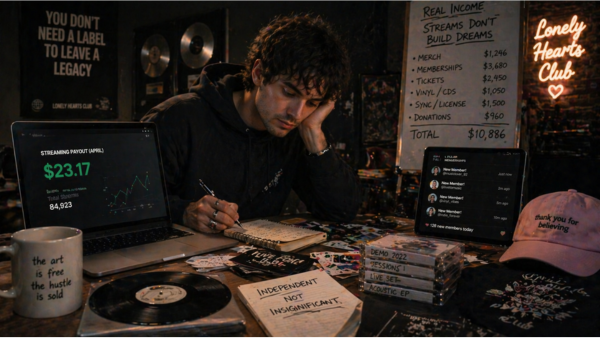
For years, the music business sold streaming as the future. In one sense, it was right: streaming is now the dominant revenue engine for recorded music. In the U.S., streaming generated $9.5 billion in 2025 and accounted for 82% of total recorded-music revenue, while paid subscriptions reached 106.5 million accounts.
But that does not mean streaming “works” equally well for artists.
That is the real tension in music right now. The industry is making more money, but many artists still cannot rely on streaming alone to build a stable career. MIDiA’s recent market analysis argues that recorded music is diversifying and that the “fan economy” is becoming central, not optional. In other words, streaming may be the engine, but it is no longer the whole vehicle.
Why Streaming Feels Broken To Artists
The biggest problem is not that streaming generates no money. It is that the money is unevenly distributed.
Streaming heavily rewards scale, repeat listening, playlist velocity, and large catalogs. That works well for superstars and rights owners with huge volume. It is much harder for mid-level and emerging artists trying to build a living from pure per-stream payouts. MIDiA has gone so far as to argue that streaming no longer builds fandom the way artists need it to, which helps explain why so many musicians are shifting focus beyond platform royalties.
Where Artists Are Actually Making Money
More and more, artists are building income through a stack instead of a single source.
That stack usually includes live shows, VIP experiences, merchandise, vinyl, sync licensing, publishing, brand partnerships, fan memberships, and direct-to-fan sales. MIDiA says the market is diversifying around streaming, with expanded rights and fan-economy revenue becoming more important. It also projects the global music merchandise market to reach $16.3 billion by 2030, which helps explain why merch is no longer just an add-on at the table by the exit.
The Real Product Is The Fan Relationship
What artists increasingly need is not just listeners. They need fans who spend.
That is why direct-to-fan strategy matters so much now. MIDiA has repeatedly pointed to fan communities as one of the best ways for artists to build meaningful connection and maximize value, and recent reporting from Billboard highlighted companies pitching direct artist payments, daily payouts, and ownership of fan data as part of a “parallel economy” for music.
Why Physical And Premium Still Matter
One of the more interesting parts of the current music economy is that digital dominance did not kill physical revenue.
RIAA says vinyl topped $1 billion in U.S. revenue in 2025, marking the nineteenth straight year of growth. That matters because it shows fans will still pay for tangible formats when those formats feel collectible, identity-driven, or emotionally meaningful. For many artists, especially those with loyal audiences, physical products can carry far better margins than passive streaming alone.
What Replaces The Old Streaming Dream
Streaming is not disappearing. It is just being demoted from “the whole business model” to “one layer of the business model.”
The replacement is a more diversified artist economy built around fandom, access, scarcity, community, and multiple revenue streams. That shift is visible in current industry data: U.S. recorded music hit a record $11.5 billion in 2025, global recorded music reached $39.5 billion by MIDiA’s estimate, and analysts increasingly describe the market as multifaceted rather than purely streaming-led.
Streaming is broken if you expect it to be enough on its own. It is not broken if you treat it as discovery, reach, and background infrastructure for a bigger business. The artists making real money now are usually not betting on one royalty check. They are building a system around fans who will buy, show up, subscribe, collect, and care. That is the model replacing the old fantasy that streams alone would save music.
Comments
No comments yet. Be the first to share your thoughts.
Log in to add a comment.