


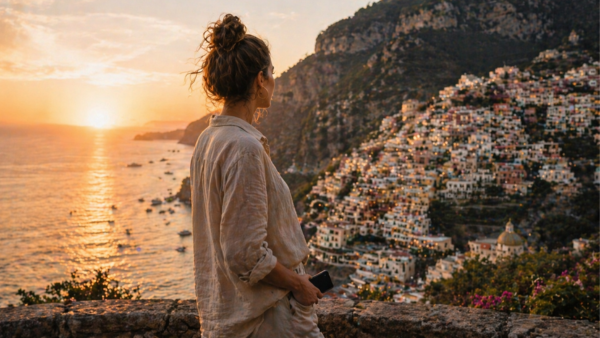
There was a time when travel and posting felt almost inseparable. If you took the trip, you shared the airport photo, the hotel view, the beach sunset, the dinner table, the outfit, the street, the proof.
Now a different kind of travel fantasy is growing: going somewhere beautiful, meaningful, or unforgettable and not posting any of it.
That shift makes sense. Social media still shapes travel behavior in a huge way, especially for younger travelers, but there are also strong signs of fatigue around performative sharing and overtourism. Booking.com reported that 44% of travelers would avoid tagging lesser-known destinations on social media to keep them from being overrun, while its 2025 global research found that 53% of travelers are now conscious of travel’s impact on communities.
Why Travel Started Feeling Like A Performance
For years, social media quietly changed the emotional structure of travel.
Trips stopped being only about rest, discovery, or experience. They also became content opportunities. A view was not just a view. It was a potential post. A meal was not just a meal. It was a possible Story. Travel became something people were living and packaging at the same time.
That double experience can make a trip feel thinner. Instead of fully entering the place, you start curating it in real time.
Why Some Travelers Are Pulling Back
Not everyone wants their vacation to become a public-facing brand moment anymore.
Part of that is exhaustion. Part of it is privacy. Part of it is the growing feeling that once every destination becomes content, the actual experience starts to get flattened. Even among Gen Z, where social media still heavily influences travel choices, only 46% report posting their travels on social platforms, which suggests that inspiration and sharing are not exactly the same behavior.
There is also a deeper cultural shift happening. Travel is becoming more personal, more intentional, and in some cases less performative. Skyscanner’s travel trend reporting describes a move toward more personalized travel behavior, while Booking.com’s data shows rising awareness of tourism’s real-world impact.
The Appeal Of Not Posting Anything
An “un-Instagrammable” trip is not really about rejecting photography or pretending social media is evil.
It is about removing the pressure to convert every meaningful moment into proof for other people. No posting schedule. No audience in the background. No subtle pressure to make the trip look important while you are still inside it.
That can make travel feel more private, more immersive, and strangely more memorable. When you are not half-thinking about captions, angles, timing, or reactions, you may pay closer attention to the trip itself.
Why “Proof” Feels Less Necessary Now
The old internet rewarded visibility. The current internet often rewards selectivity.
In a world oversaturated with content, not posting can feel more intentional than posting everything. It can signal that the trip was for living, not performing. It can also protect places from becoming the next overcrowded attraction just because they looked good in a feed. Booking.com’s research around avoiding geotags for lesser-known locations reflects exactly that tension.
That does not mean people are done sharing travel. It means more travelers seem interested in choosing what to keep for themselves.
The “un-Instagrammable” trip is not anti-social media. It is anti-obligation. It reflects a growing desire to travel without turning every beautiful moment into public evidence. And in a culture obsessed with showing where you are, there is something powerful about deciding that the experience itself is enough.
Comments
No comments yet. Be the first to share your thoughts.
Log in to add a comment.