


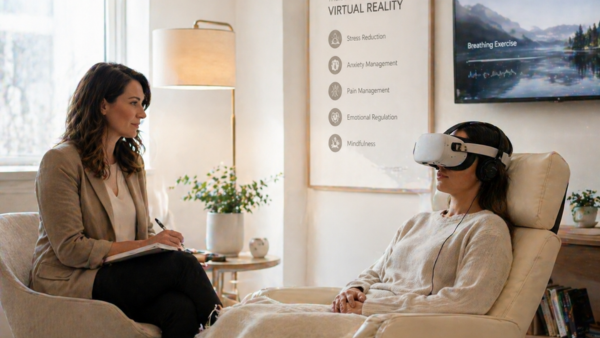
Virtual reality is finally escaping the trap that held it back for years: being seen as mostly a gaming gadget.
That shift is happening because VR makes sense in therapy in a very specific way. It can create controlled, repeatable, immersive environments where people can practice skills, face fears, manage pain, or build tolerance in ways that are hard to reproduce in ordinary clinical settings. The FDA says VR and AR medical devices have the potential to transform care by delivering immersive, tailored treatment and diagnostic experiences, and current research continues to find therapeutic promise for VR across mental health and rehabilitation settings.
Why VR Works So Well In Therapy
The biggest advantage is not novelty. It is control.
In therapy, clinicians often need a safe middle ground between talking about a problem and facing it in real life. VR can provide that bridge. It allows therapists to recreate stressful or challenging situations with more control over intensity, pacing, and repetition. That is especially relevant for exposure-based approaches, where gradually confronting fears or triggers is part of treatment. Recent research highlights VR’s promise in treating social anxiety and other psychological disorders because it can support structured, therapist-guided exposure in immersive environments.
It Is Already Moving Into Real Clinical Use
This is not just a lab concept anymore.
A 2026 implementation study described VR training being used in routine mental health care, which matters because one of the biggest historical barriers for VR therapy was not whether it could work in theory, but whether clinics could actually integrate it into practice. Newer studies are increasingly focused on implementation, adoption, and real-world workflows rather than just novelty effects.
The FDA also already classifies virtual reality behavioral therapy devices for pain relief as a medical-device category, and AppliedVR’s RelieVRx remains a prescription-use immersive VR system indicated as an adjunctive treatment for chronic lower back pain in adults.
Why Mental Health Is A Natural Fit
Mental health may be one of the strongest use cases because so much therapy depends on context, behavior, and response.
VR can simulate social environments, feared situations, or calming guided experiences in a way that is more vivid than imagination alone but safer and more flexible than real-world exposure. The APA has reported growing use of VR by psychologists, including applications that can improve mood and engagement, while recent reviews continue to describe VR-based therapies as effective or promising for anxiety-related conditions, PTSD symptoms, and related behavioral outcomes.
That does not mean VR replaces therapy. It usually works better as a tool inside therapy.
Why The Timing Feels Right Now
Part of the reason VR therapy feels more realistic now is that the technology itself is more usable.
Headsets are more familiar, software is better, and remote or at-home digital care has become less strange to both patients and providers. The FDA’s current guidance language around immersive medical devices reflects that broader shift toward treating VR as part of healthcare infrastructure rather than just consumer electronics.
There is also a larger health-tech tailwind. Reuters reported strong investment momentum in mental health platforms this year, which suggests the market is still looking for scalable, practical tools that can expand care access and improve treatment delivery.
What Will Likely Happen Next
The next phase is probably not “everyone gets therapy in the metaverse.”
It is more grounded than that. VR is likely to keep growing where it offers a clear advantage: guided exposure, pain management, rehabilitation, skills practice, and situations where immersion improves care. Research is also moving toward making VR therapy more adaptive, including work on AI-tailored virtual reality exposure therapy, which suggests future systems may become more personalized over time.
Virtual reality is becoming a therapy tool because it finally has a job that fits the technology. It does not need to replace the therapist, the clinic, or the real world. It just needs to create better practice spaces for healing, behavior change, and symptom relief. That is a much stronger role than “the future of games,” and it is why VR in therapy feels more durable now than earlier waves of hype.
Comments
No comments yet. Be the first to share your thoughts.
Log in to add a comment.